Hard freeze, frost, and a freeze warning are not the same thing
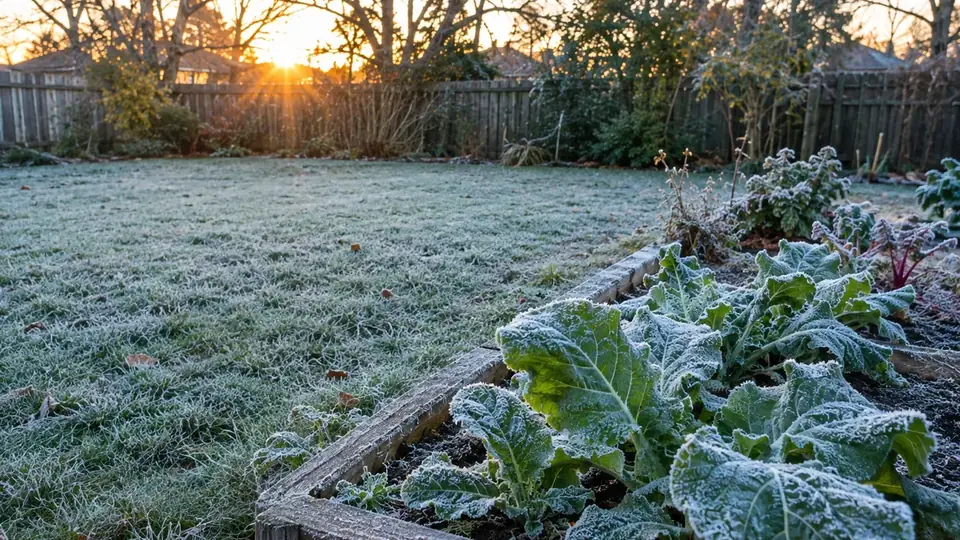
A frost is ice on the plant, and the air can still be in the middle 30s. A freeze warning is for air at or below 32°F. A hard freeze is 28°F or lower, long enough that the National Weather Service says it kills most vegetation. Since about 1 October 2024, a hard freeze is no longer its own warning. Those words can still appear inside a freeze warning.
The dates on this site are 1991 to 2020 medians, not a forecast for tonight and not a guarantee for this year. Nothing here is agricultural advice.
Three words, three temperatures
The NWS glossary describes frost as thin ice crystals on the ground or on objects. It forms the way dew does, except the surface falls below 32°F, and it often happens with the thermometer in the middle 30s because frost is mostly radiational cooling. A frost advisory, on that same page, is for widespread frost in the growing season, usually with surface temperatures in the middle 30s. The NWS cold weather page tells a reader to be aware: areas of frost are expected or occurring, and sensitive plants are at risk.
A freeze, in the glossary, is surface air expected at 32°F or below over a wide area for a climatologically significant time. The cold weather page marks a freeze warning as the product to act on: temperatures forecast below 32°F for a long period, a threshold it says kills some commercial crops and residential plants. A freeze watch is the earlier heads up, when widespread freezing is possible in the next 24 to 36 hours, used in autumn until the growing season ends and in spring when it starts.
A hard freeze, same glossary, is surface air at 28°F or lower for an extended period, killing most types of vegetation. The cold weather page says temperatures below 28°F for an extended period can kill most commercial crops and residential plants. NWS Raleigh prints local cutoffs that match those round numbers: 33 to 36°F for a frost advisory, 32°F or lower for a freeze warning, 28°F or lower for a hard freeze. That is one office. It is not a rule that every office uses the same edges.
| Word | Temperature the NWS cites | Product |
|---|---|---|
| Frost | Often the middle 30s, ice on the surface | Frost advisory during the local growing season |
| Freeze | 32°F or below, widespread, for a long enough time | Freeze warning. A watch can come 24 to 36 hours ahead |
| Hard freeze | 28°F or lower for an extended period | No longer a separate warning. The freeze warning can say hard freeze |
Service Change Notice 23-44 (updated 26 March 2024) set that consolidation for on or about 1 October 2024. The hard freeze watch became a freeze watch, and the hard freeze warning became a freeze warning. The notice says the freeze warning may still use the words "hard freeze" in the body, for example in the "what" line, when the shelter temperature is forecast at 28°F or lower. The NWS hazard simplification note describes the same change. Both pages were open on 20 Nov 2026.
Related pages
Which Frost site mark. Image policy
Anchorage frost datesWorked example: median spring dates of May 31 at 36°F, May 16 at 32°F, and May 1 at 28°F.Which Frost site mark. Image policy
Alaska frost datesWhy that station is an estimate, and how other zone 5a cities differ.Which Frost site mark. Image policy
USDA zone 5aThe winter band is not a frost date. The city rows show the spread.Which Frost site mark. Image policy
Sources and methodsWhich station a city page uses, and what the NOAA flags mean.
What extension services say the cold does to plants
The forecast words are national. The plants are not. Two extension publications, read on 20 Nov 2026, draw the line in different gardens.
University of Alaska Fairbanks Cooperative Extension, HGA-00134, says radish, turnip, carrot, leaf lettuce, and pea seed can go in before the danger of frost is past. It also lists a longer set, including beans, that may be seeded up to two weeks before the last killing frost with little danger of loss, and then says beans freeze easily and that an early bean planting needs cover when the night falls near freezing. Tomatoes, it says, go outside after the danger of frost is past and warm weather looks likely to hold. A garden in a frost pocket should be planted only with frost resistant vegetables. A few feet of extra elevation can add days. Those are Alaska sentences. The counted weeks, using a city's own NOAA median, are on the city page where this site has transcribed them. Anchorage is the one.
University of Florida IFAS, Row Covers for Growth Enhancement (CV106), is about covers in a state where a frost is an occasional event rather than the frame of the season. For frost protection it names soil cover for young crops (commonly potatoes), sprinkler irrigation, and row covers. On sprinklers, UF says freezing water gives up heat to the leaf, the plant stays protected only while water keeps coming in ample quantity, and the method is less effective in wind. On covers, UF says a nonwoven material of about 0.5 ounce per yard protects to about 30°F, and material in the 1.5 to 2.0 ounce range protects to about 25°F. Wire hoops keep the cover off the leaves. This page does not turn those Florida figures into a date for any city.
How a city page on this site lines up
Each city table has three spring thresholds and three fall thresholds: 36°F, 32°F, and 28°F. Those are NOAA's freeze probability normals, not a warning. The 50 percent column is the median. At Anchorage the median last spring dates are May 31 at 36°F, May 16 at 32°F, and May 1 at 28°F, 15 days from the 28°F median to the 32°F median. Read that as a spread in the climate record. It is not a claim that a hard freeze warning will fall on May 1 this year. The Alaska page shows why a shared USDA zone does not share that spread: Minneapolis, also zone 5a, has a median last 32°F freeze on April 23.
Related pages
Which Frost site mark. Image policy
Longest and shortest growing seasonNOAA's own season length, ranked for every city on this site.Which Frost site mark. Image policy
No computed 32°F frost dateStations where NOAA did not publish a median last spring freeze.Which Frost site mark. Image policy
Frost dates by statePick a state, then a city, and read the 36, 32, and 28 degree columns.Which Frost site mark. Image policy
USDA zonesWinter minimum bands. Open a city for the frost date.
Frequently asked questions
Is a frost the same thing as a freeze?
No. The NWS glossary describes frost as ice crystals on surfaces, often while the thermometer in the air is still in the middle 30s. A freeze is surface air at 32°F or below over a wide area for a significant time. A garden can get frost without the air reaching 32°F.
Does a freeze warning still cover a hard freeze?
Yes. Service Change Notice 23-44, updated 26 March 2024, folded the hard freeze watch and the hard freeze warning into the freeze watch and the freeze warning, effective on or about 1 October 2024. The warning text can still say hard freeze when the forecast low is 28°F or lower. There is no longer a separate Hard Freeze Warning product.
Can I treat the date on a city page as tonight's warning?
No. A city page is a 1991 to 2020 median from one NOAA station. A freeze warning is a forecast for a particular night. The median is not a guarantee that this year will match it, and it is not agricultural advice.
Sources
- NWS glossary: frost and frost advisory
- NWS glossary: freeze and hard freeze
- NWS: freeze watch, freeze warning, and frost advisory
- NWS Service Change Notice 23-44, updated 26 March 2024
- NWS hazard simplification note on cold products
- NWS Raleigh frost and freeze criteria
- UAF Cooperative Extension HGA-00134, 16 Easy Steps to Gardening in Alaska
- UF IFAS, Row Covers for Growth Enhancement (CV106)
- NOAA NCEI U.S. Climate Normals 1991 to 2020
NWS, UAF, UF IFAS, and the NCEI product page were checked 20 Nov 2026. The Anchorage dates are the same station cache retrieved 16 Nov 2026.